Constellations in Germanic Healing Knowledge: When the Brain Enters Survival Mode
In Germanic Healing Knowledge (GHK), a constellation is not a psychiatric disorder or a character flaw. It is a biological survival state that occurs when an individual is carrying two or more active biological conflicts simultaneously, with those conflicts located in opposite hemispheres of the brain.
When this happens, the brain hemispheres no longer operate in synchronized rhythm. Instead, they begin to “vibrate at different frequencies,” producing an immediate and often dramatic shift in behavior, mood, perception, or impulse control. From the outside, this can look like a sudden personality change. From a biological perspective, it is the nervous system adapting to overwhelm.
Why Constellations Exist
Constellations serve a protective biological purpose. When two opposing conflicts are active at the same time, the body halts further conflict mass accumulation. In practical terms, this means:
Tumors stop growing
Tissue loss pauses
Physical damage is limited
Rather than continuing to load stress into the organs, the brain shifts the burden into behavioral and psychological expression. This is not a failure of regulation—it is the body choosing mental adaptation over physical breakdown.
How Constellations Affect Behavior
The specific psychological or behavioral expression depends entirely on which area of the brain is involved. Each brain region carries its own evolutionary function and survival logic.
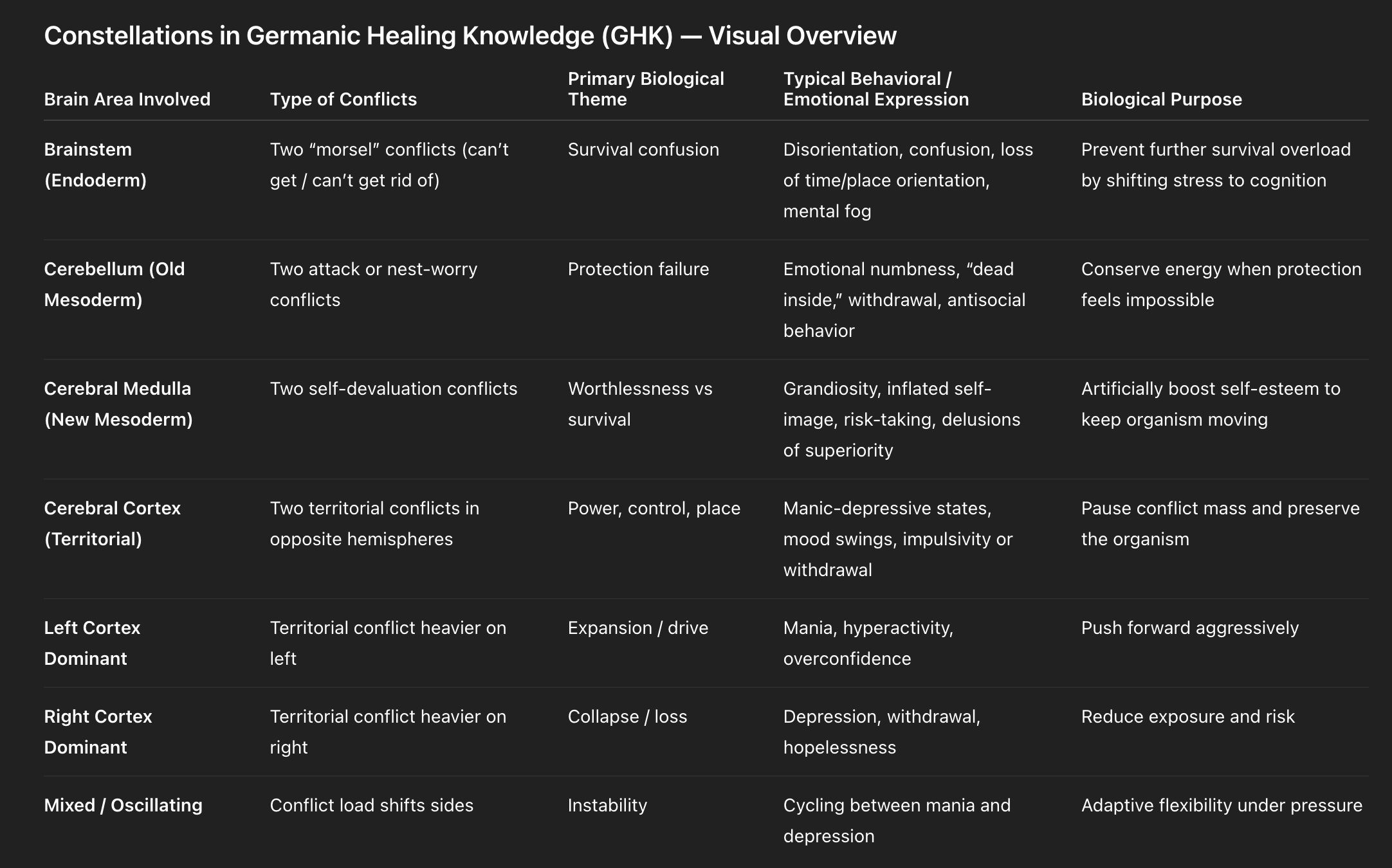
Brainstem Constellations: Disorientation and Confusion
Brainstem constellations arise from two active “morsel” conflicts, meaning survival-level issues related to obtaining or eliminating what is necessary to live.
When both hemispheres of the brainstem are involved, individuals may experience:
Profound confusion
Disorientation in time or space
Memory disruption
A sense of being “lost” or mentally fogged
From a GHK perspective, symptoms often associated with Alzheimer’s or severe cognitive decline are understood as biological bewilderment, not degeneration. The organism is overwhelmed at the most primal survival level.
Core function:
“I don’t know where I am or what’s safe.”
Cerebellum Constellations: Emotional Collapse and Numbness
The cerebellum governs protection, attack, and nest-related conflicts. When both sides are activated simultaneously, emotional systems shut down to conserve energy.
This constellation can manifest as:
Emotional numbness
A sense of being “dead inside”
Withdrawal from relationships
Antisocial or flattened affect
Rather than excessive emotion, the body produces emotional shutdown—a last-resort state when protection is no longer possible.
Core function:
“Feeling nothing is safer than feeling pain.”
Cerebral Medulla Constellations: Inflated Self-Image
The cerebral medulla is associated with self-devaluation conflicts. When both hemispheres are active, the psyche may swing in the opposite direction.
This constellation often expresses as:
Grandiosity
Inflated self-importance
Delusions of superiority
Risk-taking or exaggerated confidence
Biologically, this functions as a self-esteem emergency override. When the organism feels crushed by worthlessness, the brain artificially boosts confidence to keep the individual moving forward.
Core function:
“I must feel bigger to survive feeling small.”
Cerebral Cortex (Territorial) Constellations: Mood Extremes
Territorial constellations are the most complex and are governed by scale rules, which depend on:
Biological sex
Hormone status
Handedness
These constellations often manifest as manic-depressive states, but the dominant mood depends on which hemisphere carries more conflict mass.
Mania corresponds to the left cerebral hemisphere (the biologically “female” side)
Depression corresponds to the right cerebral hemisphere (the biologically “male” side)
A person may oscillate between states, or remain fixed in one, depending on conflict intensity and duration.
Territory, Identity & Drive Constellations
Aggressive
Postmortal
Casanova / Nympho
Mythomaniac
Anorexia / Bulimia
Flying constellation
Core function:
“I must defend, define, or escape my place in the world.”
Key Features of Constellations
Conflict Mass Pause
While a constellation is active, the body stops building additional biological conflict mass. This is why constellations often coincide with long-term psychological patterns but relatively stable organ findings.
Maturity Stop
When the second conflict occurs, emotional and psychological development may pause at that age. This explains why certain behavioral patterns feel frozen in time.
Alcohol and Intoxication
Alcohol can temporarily simulate a constellation by altering brain hemisphere coordination. Someone with only one active conflict may behave as though they are constellated—becoming aggressive, euphoric, withdrawn, or impulsive.
Tracks and Recurrence
Constellations can be:
Constant
Episodic
Triggered by specific cues (“tracks”) tied to the original conflict shocks
Recurring exposure to these tracks reactivates the constellation even if the original situation no longer exists.
Not Pathology—Biology Under Pressure
From a GHK perspective, constellations are not mental illnesses. They are high-level survival adaptations that arise when the nervous system is overloaded from multiple directions at once.
The goal of healing is not suppression or control, but resolution of the underlying conflicts, allowing the brain hemispheres to re-synchronize naturally. When that happens, the constellation dissolves on its own, without force.
Understanding constellations reframes behaviors that are often judged or feared—and replaces blame with biological clarity.
