Menstrual Health: Conflict Themes, Laterality, and the Emotional Layers Beneath the Cycle
In Germanic Healing Knowledge (GHK), menstrual symptoms are not viewed as random malfunctions or hormonal chaos. They are understood as biological programs initiated by the brain in response to specific emotional conflict shocks.
The reproductive system is highly sensitive to themes of:
Belonging
Identity
Sexual safety
Loss
Territory
Survival
To understand menstrual irregularities, painful periods, or amenorrhea, we must look at three core factors:
Which tissue is involved
Which brain relay controls that tissue
How the individual perceived the conflict
Laterality: Why Handedness Matters
Biological handedness is determined at the first cell division and plays a major role in territorial and sexual conflicts.
For a right-handed female:
Left side of body/brain → Mother/child themes
Right side of body/brain → Partner themes (father, boyfriend, siblings, coworkers, rivals)
For a left-handed female, this is reversed.
This matters because territorial or sexual conflicts impact specific hemispheres, which then influence:
Hormonal status
Mood (manic vs depressive perception)
Whether menstruation continues or stops
The Major Reproductive Programs
1. Ovaries (New Mesoderm)
Conflict Theme:
A deep loss or fear of loss — involving a loved one, friend, pet, or even loss of one’s perceived fertility or desirability.
Conflict-Active Phase:
Ovarian necrosis (tissue loss)
Drop in estrogen
Possible cycle interruption
Healing Phase:
Formation of an ovarian cyst
After maturation (~9 months), the cyst becomes functional tissue
Increased estrogen production
Biological purpose:
To compensate for the loss by increasing fertility potential.
2. Uterine Mucosa (Endometrium – Brainstem)
Conflict Theme:
Procreation conflict
Implantation conflict
“Ugly gender conflict” with a male (feeling insulted, degraded, or disrespected as a woman)
Conflict-Active Phase:
Tissue growth (thickening) to improve implantation chances
Healing Phase:
Microbial breakdown of excess tissue
Heavy bleeding
Discharge
Night sweats
What is often labeled as “abnormal bleeding” is, in this model, healing tissue being cleared.
3. Uterine Muscle (Myometrium)
Conflict Theme:
“Not being able to hold the fetus.”
This may be literal (fear of miscarriage) or symbolic:
Fear of pregnancy
Fear of sexuality
Fear of becoming a woman
Feeling unsafe in female identity
Conflict-Active Phase:
Fibroid growth (muscle strengthening)
Healing Phase:
Intense cramping
Heavy bleeding
Unlike mucosal growth, fibroids often remain permanently to “strengthen” the uterus.
4. Cervix (Ectoderm)
Conflict Theme:
Sexual or reproductive frustration.
Often experienced as:
“Who is my male?”
Feeling rejected by a partner
Lack of protection from father or mate
Sexual competition
Conflict-Active Phase:
Ulceration (tissue erosion)
Biologically widens cervical passage
Healing Phase:
Tissue restoration
Swelling
“Abnormal cells” often diagnosed here
The Menstrual Cycle and Hormonal Shifts
The biological brain prioritizes survival and reproduction, not ideology, preference, or social timing. When a territorial or sexual conflict becomes active, the reproductive system adapts based on handedness and hemisphere involvement.
Right-Handed Female (RHF)
When a right-handed woman with normal hormone status experiences her first territorial or sexual conflict:
The conflict impacts the left cerebral hemisphere
The “female territorial side” functionally closes
The right (male) side becomes more dominant
She shifts into a more “male-brained” stress perception
Ovulation halts
The menstrual cycle often stops immediately (secondary amenorrhea)
This shift increases a more action-oriented, defensive hormonal pattern. Biologically, reproduction pauses until territorial safety is restored.
Left-Handed Female (LHF)
In a left-handed woman, the hemispheric response is reversed.
With a first territorial or sexual conflict:
The conflict impacts the right cerebral hemisphere
Hormonal perception does not immediately shift to a male-brained state
The menstrual cycle often continues
In some cases, menarche may even begin earlier if the conflict occurs before puberty
However, if a left-handed female experiences a second territorial conflict in the opposite hemisphere, she may enter a territorial constellation. At that point:
Hormonal balance shifts
Ovulation may stop
Menstruation can cease

Effects of Territorial Conflicts
Additional Emotional Layers That Deepen Understanding
Beyond structural tissue programs, several emotional “flavors” add nuance:
1. Non-Acceptance of Femininity
Painful periods may reflect:
Feeling unsafe as a woman
Growing up with a father who disrespected women
A mother who carried shame about femininity
Internalized fear of being seen sexually
The body may interpret:
“It is dangerous to be a woman.”
2. The “Refusal to Bend”
Cramps and rigidity can symbolize:
Not wanting to submit
Refusing to soften
Holding tension against vulnerability
The uterus becomes a site of defensive contraction.
3. Financial Survival Anxiety
A subconscious fear of:
“Will we make it this month?”
Can overlap with:
Existential stress
Territorial insecurity
End-of-cycle tension
The biological brain does not separate “money stress” from survival threat, making it not safe to procreate.
4. The Role of the Kidney Collecting Tubule (KCT) Conflict
If an individual is simultaneously experiencing:
Abandonment
Isolation
Refugee feeling
“Fish out of water” existence stress
The body retains water. This retained water can migrate to any tissue in healing, including uterine or cervical tissue, intensifying:
Swelling
Cramping
Heavy bleeding
Weight gain
In these cases, the abandonment theme amplifies menstrual symptoms dramatically.
Breakthrough Bleeding (Metrorrhagia)
Spotting between cycles may involve:
Pregnancy ambivalence (wanting and fearing simultaneously)
Distrust of men
Fear of being “drained” or used
Symbolic unresolved procreation grief
Again, these are refinements of the core procreation program, not separate mechanisms.
What Resolution Requires Biologically
Within this model, the body needs:
Safety in belonging
(Resolution of abandonment/existence themes)Safety in femininity
(Being a woman is not dangerous)Clarity in identity
(Knowing where one belongs)Relief from territorial pressure
(No longer fighting for space)Permission to mature
(It is safe to grow up)
When these perceptions shift, hormonal scales recalibrate naturally. The cycle returns when the brain perceives:
“It is safe to be a woman here.”
A Grounded Perspective
The menstrual cycle is deeply relational. It responds to:
Safety
Belonging
Sexual identity
Loss
Territory
Survival
And sometimes, what appears hormonal is profoundly emotional. Understanding the conflict themes provides language for meaning where there was only fear.
Case Studies: Menarche
Case Study 1
Right-Handed Girl – Delayed Menarche
Background:
Emily, age 15, right-handed, had not yet started her period. Physically she appeared younger than her peers and often described herself as “still feeling like a kid.”
History:
At age 11, her parents went through a highly conflictual divorce. During that time, she felt caught in the middle and unsure where she belonged. She frequently thought:
“I don’t know whose side I’m on.”
“I don’t want to choose.”
GHK Interpretation:
In a right-handed female, an identity or territorial conflict impacts the left hemisphere first (the feminine territorial side). When that side becomes conflict-active:
The hormonal balance shifts toward a “male-brained” perception.
Ovulation pauses.
Menarche can be delayed.
Biological Meaning (GHK model):
The brain may interpret instability as “unsafe to become a woman.” Reproductive maturation pauses until territorial safety and identity clarity are restored.
Case Study 2
Right-Handed Female – Secondary Amenorrhea
Background:
Sofia, age 19, right-handed, had regular cycles until entering a romantic relationship that ended abruptly and humiliatingly.
After the breakup:
Her period stopped immediately.
She felt driven, restless, and hyper-focused on “proving herself.”
She reported feeling emotionally harder and less vulnerable.
GHK Interpretation:
The sexual frustration/territorial conflict impacts the left hemisphere first in right-handed females. This shifts her into a temporary “male-brained” stress perception.
Result:
Ovulation stops.
Menstruation halts.
Emotional tone becomes more driven or combative.
Her cycle returned months later after she felt stable and secure again.
Case Study 3
Left-Handed Girl – Early Menarche
Background:
Lily, age 10, left-handed, began her period unusually early. Around that time, she had transferred schools and was struggling socially.
She frequently said:
“I don’t know where I fit.”
“They don’t want me.”
GHK Interpretation:
In a left-handed female, hemispheric assignments are reversed compared to a right-hander. An early territorial or identity conflict may stimulate reproductive activation rather than suppress it.
In this model:
The territorial area is activated.
Hormonal shifts may accelerate puberty.
Menarche begins earlier than expected.
Biological Meaning (GHK view):
The system may respond to insecurity by accelerating reproductive readiness.
Case Study 4
Territorial Constellation and Maturity Stop
Background:
Ava, age 13, right-handed, experienced bullying (identity conflict) and ongoing tension at home (territorial anger conflict). She appeared emotionally frozen and physically underdeveloped.
Symptoms:
Delayed puberty
No breast development
No menstruation
Flat emotional expression
GHK Interpretation:
Two active territorial conflicts in opposite hemispheres create a territorial constellation.
Possible effects:
Hormonal suppression
Maturity stop at the age of the second conflict
Amenorrhea
Biological Meaning (GHK lens):
The system determines that becoming reproductively mature is unsafe in the current environment.
Key Themes Across Cases
In the GHK model:
Menarche reflects perceived territorial and relational safety.
Handedness determines which hemisphere is impacted first.
One conflict may delay or accelerate puberty depending on laterality.
Two conflicts (constellation) can halt development entirely.
Case Studies: Cramps
Case Study 1: Severe Menstrual Cramps (Dysmenorrhea)
Client: 24-year-old right-handed woman
Presentation: Debilitating cramps beginning 24–48 hours before bleeding. Heavy clotting. Cycles otherwise regular.
History
At age 16, she experienced a pregnancy scare that felt catastrophic. Her internal dialogue at the time:
“I cannot handle this.”
“My life would be over.”
“I’m not ready to be a mother.”
Although she was not pregnant, the shock stayed in her system. Each month before bleeding she reported:
Anxiety
Irritability
Tightness in her lower abdomen
Fear she “wasn’t in control”
GHK Interpretation
Cramps are understood as the Epileptoid Crisis within the healing phase of a uterine program.
Depending on the tissue involved:
Endometrium (mucosa) → procreation conflict
Myometrium (muscle) → “not able to hold fetus” conflict
In this case, the original shock was fear of pregnancy and inability to carry it safely. During the active phase, the uterine muscle strengthens (fibroid-type program). During healing, the muscle contracts intensely to expel repair edema — experienced as severe cramping.
Biological Meaning (GHK model)
The cramps are the “big squeeze” — the uterus attempting to normalize after repair.
Her pain reduced significantly after she processed the original pregnancy fear and reframed motherhood as future-based rather than immediate threat.
Case Study 2: Recurrent Cramps Linked to “Refusal to Bend”
Client: 31-year-old woman with painful periods since adolescence
History
She grew up with a father who frequently said:
“Don’t be weak.”
“Don’t act like a girl.”
“You’re too emotional.”
Internally she developed a subtle rejection of femininity and sexuality. Her cramps worsened during relationships where she felt pressured or controlled.
GHK Interpretation
Recall Healing language frames dysmenorrhea as sometimes linked to:
Non-acceptance of femininity
Refusal to “bend” or submit
Anger about being a woman
In GHK terms, this may activate:
Uterine mucosa healing (heavy bleeding)
Cervical healing (swelling and inflammation)
Muscle crisis (cramping)
Biological Meaning
The body expresses unresolved tension around womanhood, sexuality, and submission themes. As she developed a secure sense of femininity and autonomy, her cramps gradually softened.
Case Studies: Infertility
Case Study 3: Ovarian Loss Conflict & Temporary Infertility
Client: 35-year-old right-handed woman struggling to conceive
History
Two years earlier she lost her younger brother unexpectedly. After the loss:
Her cycles became irregular
She reported emotional numbness
Libido disappeared
GHK Interpretation
The ovaries (new mesoderm) respond to a profound loss conflict.
Conflict-active phase:
Ovarian necrosis (tissue loss)
Reduced estrogen
Suppressed ovulation
Healing phase:
Ovarian cyst formation
Later increased estrogen production
Her infertility corresponded with the active loss phase — low estrogen and no ovulation.
Biological Meaning
The body interpreted the environment as unsafe for reproduction during grief. Once grief processing began and hormonal balance restored, ovulation resumed.
Case Study 4: Amenorrhea After Sexual Frustration (Right-Handed Female)
Client: 27-year-old right-handed woman
Presentation: Period stopped after betrayal in a long-term relationship.
History
She experienced intense humiliation and sexual rejection. Her internal narrative:
“I wasn’t chosen.”
“I must not be enough.”
GHK Interpretation
In a right-handed female, the first sexual or territorial conflict impacts the left hemisphere.
This shifts hormonal balance to a temporary “male-brained” stress state:
Ovulation stops
Menstruation halts
Testosterone perception increases
Infertility here was not ovarian failure but territorial-sexual conflict activity.
Biological Meaning
Reproduction pauses when mating safety feels compromised. Her cycle returned after she regained relational security and internal stability.
Case Study 5: Amenorrhea & Infertility in a Left-Handed Female
Client: 32-year-old left-handed woman
Presentation: Irregular ovulation progressing to missed periods while trying to conceive.
History
She described two major relational shocks:
A breakup in her early twenties where she felt replaced.
Ongoing doubt in her current marriage about whether her partner was emotionally dependable.
Her internal narrative:
“I don’t know if I truly belong here.”
“Can I trust this?”
“What if I choose wrong again?”
She desperately wanted a baby — but simultaneously felt unsettled about her relational foundation.
GHK Interpretation
In a left-handed female, the first territorial or sexual conflict impacts the right hemisphere. Unlike a right-hander, this does not immediately stop menstruation. Ovulation may continue initially. However, when a second territorial or identity conflict impacts the opposite hemisphere, she enters a territorial constellation.
At that point:
Hormonal balance shifts
Ovulation becomes inconsistent
Periods may stop (secondary amenorrhea)
Fertility pauses
Her infertility was not ovarian failure.
It was the biological result of unresolved territorial and identity conflicts running simultaneously.
Biological Meaning
For a left-handed woman, reproduction pauses when:
Territory feels unstable
Partnership safety is uncertain
Identity within the relationship feels unresolved
The system does not proceed with pregnancy when the internal question is:
“Is this a safe place to bring life into?”
Resolution
As she worked through:
Fear of relational betrayal
Clarifying her sense of belonging
Rebuilding internal safety independent of outcome
Her cycles gradually stabilized. Ovulation returned. Infertility in this case was not dysfunction. It was biological caution. When safety was restored, reproduction resumed.
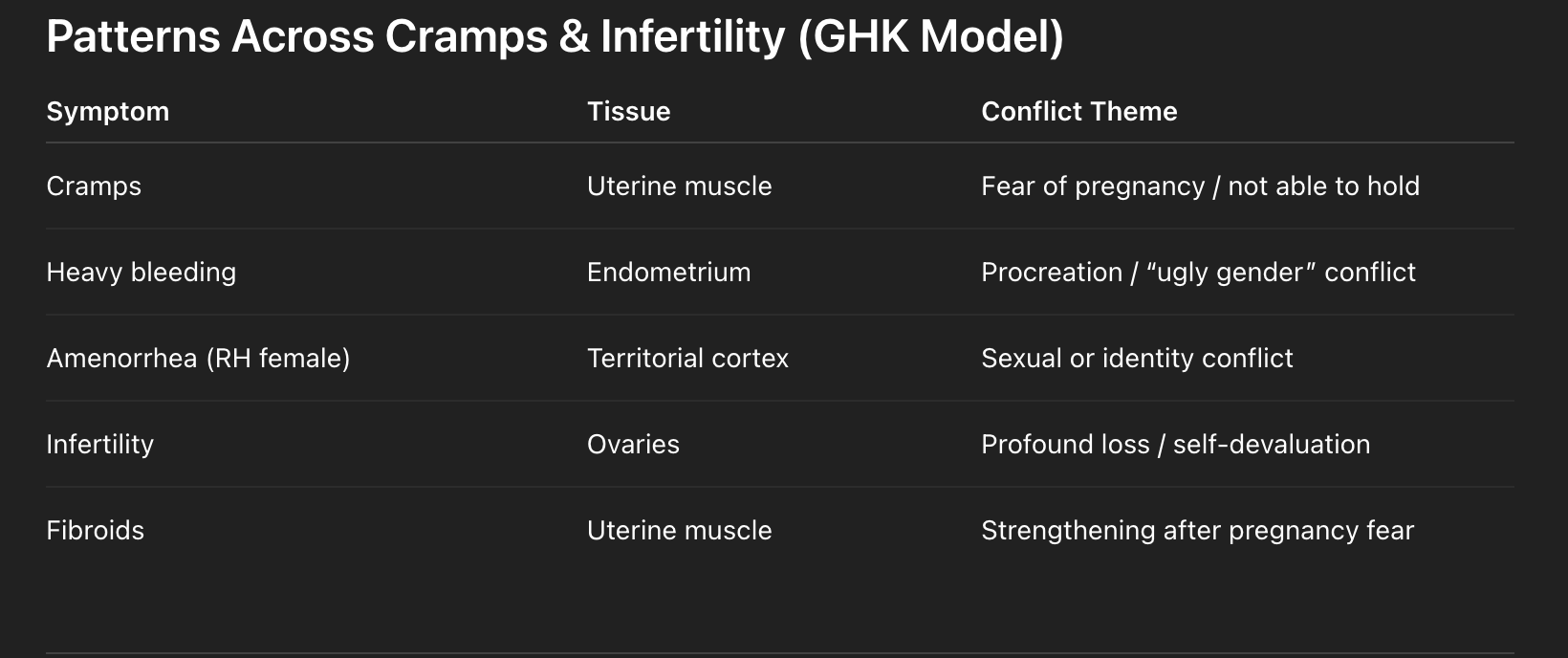
Patterns
Core Biological Thread
Reproduction pauses or intensifies based on perceived:
Safety
Territory stability
Partner reliability
Identity clarity
Loss resolution
The biological brain prioritizes survival before reproduction.
