Understanding Skin Conditions as Biological Adaptations
In Germanic Healing Knowledge (GHK), the skin is not treated as a single organ with random pathologies, but as two distinct biological systems, each with its own embryological origin, brain control center, conflict theme, and healing pattern.
Understanding whether a skin symptom involves the epidermis or the dermis (corium skin) is essential—because the same visible symptom can have entirely different meanings depending on which layer is involved.
The Two Layers of the Skin
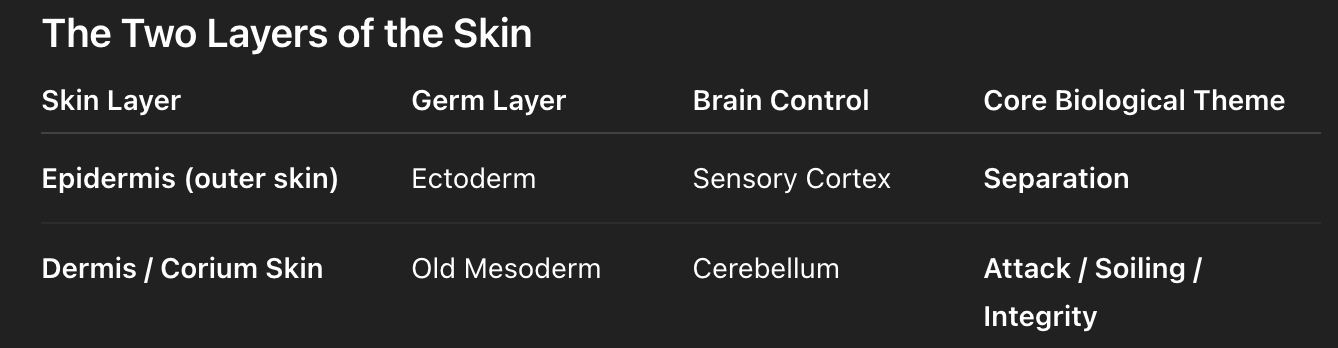
These layers often overlap in symptoms—but biologically, they respond to very different life experiences.
THE EPIDERMIS (Outer Skin)
Separation, Contact, and Loss of Touch
Biological Function
The epidermis is responsible for:
Touch and sensation
Temperature perception
Physical contact and boundary awareness
In evolutionary terms, the epidermis helps mammals stay connected to the pack through skin-to-skin contact.
Core Conflict Theme: Separation
A separation conflict involves:
Loss of physical contact
Wanting contact but being unable to have it
Wanting to separate but being unable to push away
Importantly, the psyche does not distinguish between:
Physical separation
Emotional separation
Anticipated or imagined separation
Conflict-Active Phase (CA) – The “Cold” Phase
During active separation conflict:
Microscopic ulceration of the epidermis
Reduced blood flow → cold, pale, dry skin
Decreased sensitivity (numbness)
Hair loss when the scalp is involved
Flaking, cracking, dandruff
Memory suppression related to the person separated from
Biological purpose:
To reduce sensitivity so the organism can better tolerate loss or unwanted contact.
Healing Phase (PCL) – The “Warm” Phase
Once separation is resolved:
Cell proliferation restores epidermis
Swelling, redness, warmth
Itching, burning, tingling
Blisters or oozing
Skin rashes and eruptions
This is when symptoms appear.
GHK considers most skin “diseases” to be healing-phase phenomena, not active pathology.
Epidermis-Related Conditions
All of the following are understood as healing phases of separation conflicts, unless otherwise noted:
Eczema / Dermatitis
Psoriasis (overlapping CA + healing)
Hives (urticaria)
Rosacea (face-related separation)
Herpes / Cold sores
Chickenpox, measles, rubella
Vitiligo (deep, “brutal” separation)
Hair loss (conflict-active phase)
Warts (excessive or repeated healing)
Skin tags (chronic healing with relapse)
Laterality Matters
Right side of the body → partner-related separation (for right-handers)
Left side → mother/child-related separation
THE DERMIS (CORIUM SKIN)
Protection, Integrity, and Being “Attacked”
Biological Function
The dermis:
Provides physical protection
Produces melanin (pigmentation)
Contains sweat and sebaceous glands
Acts as the body’s biological armor
Core Conflict Theme: Attack or Feeling Soiled
Dermal conflicts involve:
Physical attacks (hits, injuries, surgeries)
Verbal attacks (“cutting words”)
Sexual violations or humiliation
Feeling defiled, dirty, or contaminated
Disfigurement conflicts
Fear of contamination or disease
These conflicts are experienced as threats to bodily integrity.
Conflict-Active Phase (CA)
During active attack conflict:
Cell proliferation in dermis
Increased melanin production
Thickening of the skin
Formation of pigmented growths
Biological purpose:
To create “thicker skin” and reinforce protection.
Healing Phase (PCL)
After conflict resolution:
Bacterial or fungal breakdown of excess tissue
Swelling, redness, pain
Foul-smelling discharge or pus
Night sweats
Softening or breakdown of growths
Dermis-Related Conditions
These involve attack or soiling conflicts, not separation:
Melanoma (pigmented protection response)
Boils, carbuncles, abscesses
Acne (healing phase)
Sebaceous cysts
Excessive sweating (hyperhidrosis)
Strong body odor during healing
Shingles (dermis healing + epidermis involvement)
Kaposi sarcoma (soiling + identity fear)
Pigmentation and the Dermis
Melanin production is protective, not malignant.
Pigmentation changes may reflect:
Long-standing attack themes
Residual adaptations
Completed biological programs
This includes:
Moles
Café-au-lait spots
Pigmented scars
Nevi (including conjunctival nevus)
The Role of “Hanging Healing”
Chronic skin conditions occur when:
Conflicts repeatedly reactivate
Emotional triggers (“tracks”) persist
The healing phase never completes
This explains why:
Symptoms come and go
Treatments seem to “work temporarily”
Stress worsens skin conditions
A Different Way of Seeing Skin
From a GHK perspective, the skin is not malfunctioning.
It is:
Remembering contact
Responding to boundaries
Protecting integrity
Adapting to relational experience
Skin symptoms often soften—not through suppression—but through resolution, safety, and reconnection.
Closing Reflection
Skin does not randomly betray us.
It expresses:
Where connection was lost,
where boundaries were crossed,
and where protection was once needed.
Understanding the layer involved changes everything.
